

ANALYTICAL BRIEFING | OCTOBER 26, 2026
“So look, on the ballot, it’s been finalized. It’s going to say Sullivan, comma, Dan S., importantly, Kim, it’s going to say Republican slash incumbent. So that is what’s going to be on the ballot. The sham candidate, again, who is put on there to confuse Alaskans, is going to be listed as Sullivan Daniel J. with no other indicator of a party or anything else. We think that’s going to be enough to educate Alaskans on.“
— Sen. Dan S. Sullivan, Republican incumbent
on All Things with Kim Strassel
July 22, 2026
In an editorial published Oct. 23 (and in the Oct. 24 print edition), the Wall Street Journal took up the situation in Alaska’s U.S. Senate race, where two candidates named Sullivan are on the ballot: Sen. Dan S. Sullivan, the Republican incumbent, and Daniel J. Sullivan Jr., a challenger.
Two candidates with the same name is, in this case, a disgusting dirty trick, I agree. But the facts are clear on multiple points: it is not going to hurt Alaska’s voters nor change who wins, and it is not a reason to oppose Alaska’s Final Four Elections system.
Here is what the Journal said, in “Exposing ‘Decoy Dan’ in Alaska“:
“Polls show the Senate race within one or two percentage points. That means the election could be decided by a few thousand votes or less. Daniel J. Sullivan received 4,107 votes in the primary, roughly 2.5% of the total. ‘There is a realistic chance that, even if a majority of Alaskans wish to vote for Senator Sullivan, Daniel J. Sullivan’s presence on the ballot will result in a victory for Peltola,’ the lawsuit says.
Alaska’s convoluted ranked-choice voting system increases the risk of voter confusion.”
The Journal makes two claims: that the ballot is confusing, and that a few mistaken votes for the wrong Sullivan could hand the race to Mary Peltola. Neither holds up.
1. The ballot is not confusing
Here is the top of the official State of Alaska ballot, through the U.S. Senate race (Alaska Division of Elections; House District 4 shown):
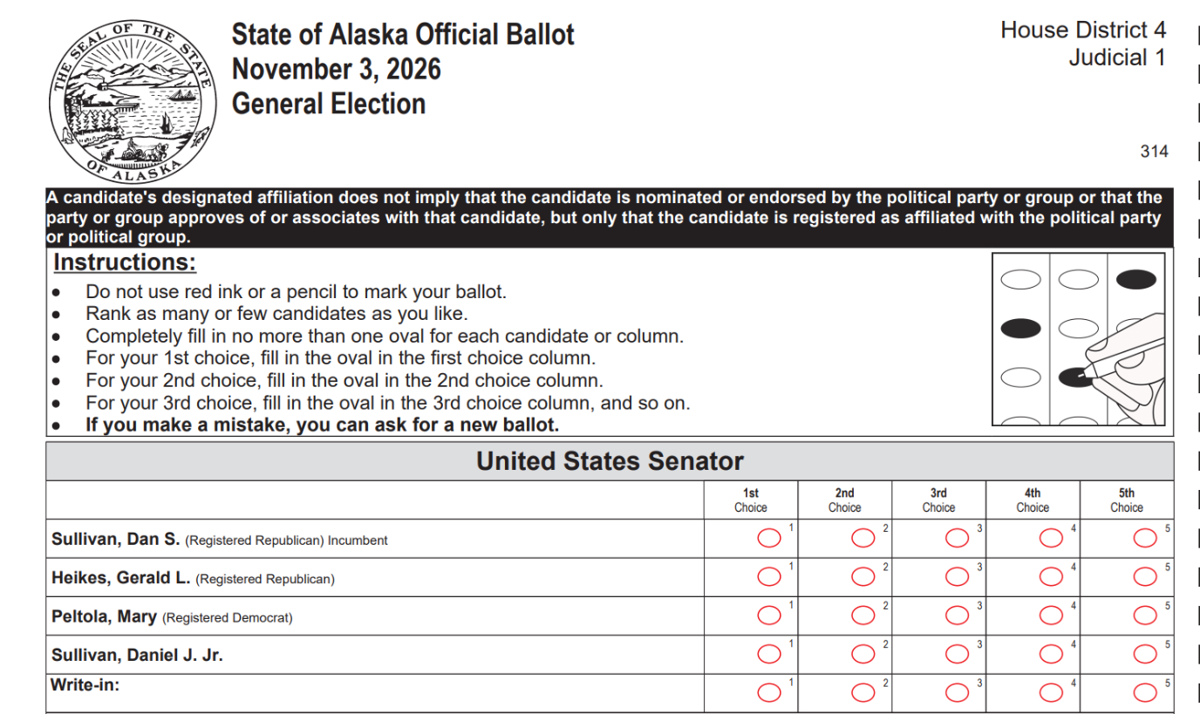
As you can see, the incumbent is listed as “Sullivan, Dan S. (Registered Republican) Incumbent.” The challenger is listed as “Sullivan, Daniel J. Jr.” with no party affiliation and no “Incumbent.” Voters can tell them apart.
Sen. Sullivan himself said as much on July 22 on Wall Street Journal editorial board member Kimberley Strassel’s podcast, All Things with Kim Strassel:
“So look, on the ballot, it’s been finalized. It’s going to say Sullivan, comma, Dan S., importantly, Kim, it’s going to say Republican slash incumbent. So that is what’s going to be on the ballot. The sham candidate, again, who is put on there to confuse Alaskans, is going to be listed as Sullivan Daniel J. with no other indicator of a party or anything else. We think that’s going to be enough to educate Alaskans on.“
Senator Sullivan is right. The Wall Street Journal editorial board is not.
2. A mistaken vote for the wrong Sullivan won’t decide the race
The Journal’s second claim is that even if only a few voters mark the wrong Sullivan, mistakenly or by accident, Mary Peltola could win. Under Alaska’s instant runoff, that is not what will happen. Here’s why.
If Sen. Sullivan wins more than 50% of first choices, he has won outright, and the challenger made no difference.
If Mary Peltola wins more than 50% of first choices, she has won outright. That means all the other candidates put together, both Sullivans, the other Republican on the ballot and the write-ins, did not reach 50%. In that case, Daniel J. Sullivan Jr. made no difference to the outcome.
If no one wins a majority in the first round, the count goes to further rounds. When Daniel J. Sullivan Jr. (i.e., the challenger) is eliminated, each of his ballots moves to the next candidate that voter ranked. A voter who wanted Sen. Sullivan and somehow marked the challenger first (which candidly beggars belief, given the ballot above) can rank the incumbent, clearly labeled “Registered Republican” and “Incumbent,” as a next choice. That ballot then counts for Sen. Sullivan. Under the old pick-one plurality system, the same mistaken vote would simply have been lost. Ranking actually protects voters from this kind of mistake.
On Oct. 14, on Wall Street Journal editorial board member Kimberley Strassel’s podcast, All Things with Kim Strassel, Republican Sen. Bill Cassidy of Louisiana put it plainly:
“We got Dan Sullivan in Alaska who is contending with somebody who put up with the same name to take away votes from him. But ranked choice voting will actually work for him.”
Senator Cassidy is right. The Wall Street Journal editorial board is not.
Katherine Gehl
Founder, Institute for Political Innovation